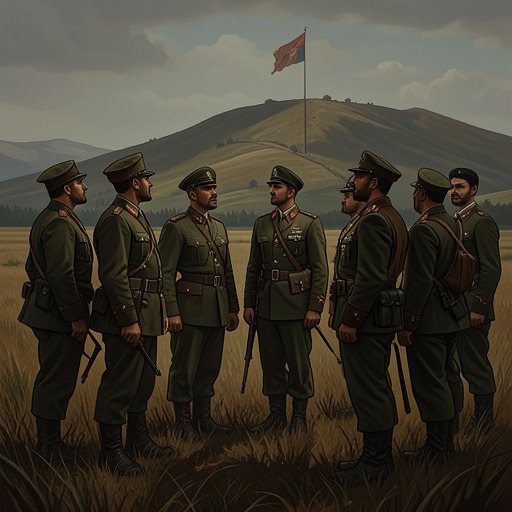
The Bonaparte Revolution
The DispossessedThe Benbili Revolution begins as news from a poor, distant country and becomes a measure of the gap between political language and political action. The rebels’ seizure of the capital and release of prisoners awaken hope in Shevek; A-Io’s armed intervention turns that hope into revulsion and places the uprising within the rivalry between A-Io and Thu. The crisis also brings wartime restrictions closer to Shevek’s own life, showing that the supposedly orderly world of Urras can confine outsiders and control knowledge as readily as it can project force abroad.
Causes and Political Background
The news arrives in emphatic headlines announcing that revolutionaries hold the capital and the dictator has fled. The popular papers render events in an excited, compressed idiom, with spelling and grammar giving way to an unstable present tense. Their voice contrasts with the brief, dry official reports. Shevek looks up Benbili in an encyclopedia: formally a parliamentary democracy, it is in practice a military dictatorship run by generals. It is a large, poor, underpopulated country of mountains and arid savannahs. The uprising is thus presented through two competing registers—official summary and popular urgency—before its stakes become clear to him.
The rebels hold Meskti, Benbili’s capital, while the retreating army burns fields and towns. Guerrillas harry the army, and the revolutionaries open the jails, granting amnesty to the prisoners. President-General Havevert escapes in his armored airplane; some lesser generals are captured and subjected to emasculation, a punishment traditionally preferred in Benbili to execution. These details make the revolution more than a change of leadership: the rebels challenge the military order, release those it imprisoned, and confront an army willing to devastate its own country as it retreats.
A-Io’s Intervention and Shevek’s Response
Shevek follows the reports with growing intensity. The release of the prisoners makes his heart leap; in the distant revolt he sees that hope remains possible. On the fourth day, however, a broadcast of debate in the Council of World Governments brings a reversal. The Ioti ambassador announces that A-Io is sending armed reinforcements to President-General Havevert, claiming to support Benbili’s democratic government. The justification sits uneasily beside the account of a military dictatorship and a popular rebellion against it.
The imbalance in force sharpens the reversal. The revolutionaries are mostly unarmed, while the Ioti arrive with guns, armored cars, airplanes, and bombs. Reading about that equipment, Shevek feels sick; his hope for the rebels becomes anger at the threat they face. He has no one around him with whom he can speak freely. Atro is an ardent militarist, and Oiie’s attachment to property and law and order leads him to explain the conflict as a struggle between A-Io and Thu rather than as a question of who governs Benbili. Oiie argues that the rebels are learning that freedom without weapons cannot defend itself. Shevek repeats Oiie’s phrase, “The politics of reality,” and notes its strangeness coming from a physicist: the phrase treats power as the decisive reality while pushing the Benbilis’ political agency to the margins.
War, Restrictions, and Political Power
A-Io’s intervention also changes the conditions under which Shevek lives and works. Oiie explains that the two rival powers will not invade each other, but calls the military action in Benbili a police action that maintains the balance of power. Although the states are officially at war, he presents the consequences on Urras as manageable: research at the College of Noble Science is subject to classification, publication may be delayed if officials consider a paper dangerous or incomprehensible, and non-nationals such as Shevek are not supposed to leave the campus without the Chancellor’s clearance. Oiie offers to get him around the restrictions. His casual confidence in evading the rules does not undo the fact that wartime authority has restricted research and movement.
The episode resonates with the institutions Shevek has already encountered on Anarres, though the mechanisms differ. There, administrative coordination has required a center in Abbenay, and the settlers recognize centralization as a continuing threat that demands vigilance. Shevek has also found that PDC port managers can stop letters to Urrasti scientists: mathematicians’ correspondence is suspected of being coded, and letters to physicists require Sabul’s approval. In his argument with Bedap, the danger is not a formal government but a social power that can suppress ideas by ignoring them and denying their authors the chance to publish, teach, or work. Against those experiences, the Urrasti response to war makes coercion more visible and official: classification and campus restrictions are attached to the state of war, even as personal connections offer ways around them.
Aftermath and Significance
The novel’s later scenes place the Benbili intervention beside other forms of political force without making them identical. In Capitol Square, an immense crowd gathers, marches, sings, and listens to speakers before helicopters drown out the words with gunfire. The violence makes the fragility of public assembly and political speech unmistakable. At the Terran embassy, the envoy tells Shevek that he has a right to be there because the embassy represents the Council of World Governments, not A-Io, and that the castle is Terran soil. Elsewhere, the closure terms for the Anarres settlement are invoked to state that arrivals from Urras may not leave the freight ships beyond the port boundary. Across these different situations, political authority appears through control of weapons, territory, access, and movement.
The Benbili uprising therefore functions as more than a foreign crisis in the background of Shevek’s visit. Its changing fortunes expose the distance between A-Io’s claim to defend democracy and the armed support it gives a fleeing military ruler, while Oiie’s account reduces a rebellion to the strategic balance between rival powers. For Shevek, the rebels’ vulnerability makes the political stakes bodily and immediate: freedom is not secured merely by naming it, yet force deployed in its name may serve the interests of states rather than the people whose freedom is at stake. The episode deepens his estrangement from Urras’s assurances of political realism and prepares the moral contrast between popular hope and the machinery sent to contain it.